




James Gleeson - Australia's foremost Surrealist an exhibition at Coffs Harbour Regional Gallery. I caught this exhibition on its final day which might give some indication of how much I was looking forward to seeing it. Gleeson is one of my daughters favourite artists and she had timed a visit home so she could see his paintings and mixed media drawings. I couldn't go with her that day and when she came home raving about the eloquence his work and how I would love the way he combined printed images with drawings I listened politely. I knew there would be intestines, and worse, and there was. And lots of them.
There was also other familiar Gleeson themes like the gentle waves on a calm secluded strangely familiar beach, the shells from that beach grown large and bursting with, well, maybe not intestines but something ominously internal. Naked men provide a realistic counterpoint to the wrenching disemboweled images, often sharing the same frame. Surprisingly their full frontal nudity provide the only images of genitalia. These are not latent sexual images from a sick mind.
There is beauty (somehow!) here too. It is the light and the colours the light illuminates, soft emerald greens, rosy pinks and deep magenta (where I feared there would be venous blue, membrane grey and blood red). The wrenching and tearing fails to extinguish hope, but instead seems to open the picture plane to allow entry of hope through the exquisite light. How is that possible?
At this time when I am planning to push my creative boundaries, and have actually allowed play to replace the seriousness I had allowed to creep in, the glow of Gleeson's light reminds me that the creative journey is always individual and that it really is OK to be me, warts, intestines and all. And really if it has served me no other purpose than to remind me to get back to drawing my deck of cards with alternate suits, one of which is body parts, it has served me well. I do believe I was up to the Ace of intestines...
Thursday, August 21, 2008
Inner Glow

Wednesday, August 06, 2008
The Sydney Biennale Part II
 What does it mean when I forgo seeing the prime work of my creative hero? I went to Sydney at Biennale time to see the work of William Kentridge, specifically the exhibition Telegrams from the Nose at Annandale Galleries. While not a Biennale event in itself the exhibition had been timed to support Kentridge’s work that was the Biennale ‘highlight’ at the Cockatoo Island exhibitions. William Kentridge has enthralled me ever since I first ‘discovered’ him at the MCA several years ago. I’ve seen as much of his work as is possible here in Australia, quite some distance from his homeland, South Africa.
This visit to Annandale Galleries I saw his stationary movie - the viewer moves not the image, his stereographs - prints viewed through eyeglasses that develop amazing 3D depth, and an animation - images drawn in charcoal on paper are erased and redrawn to create movement and tell the story. I was elated.
The day to go to Cockatoo Island dawned. Yes, it was cold and a little drizzly, but would I let that stop me? No, I let the word ‘Island’ stop me. My seasickness is legendary. I’ve been sea sick in a dugout canoe on a sea that was a flat as glass, on a boat on a river, and once on a yacht I jumped overboard and swam to shore to get away from it. I know from first hand experience why they don’t have guns on boats because on a 2 hour cruise I would have gladly chosen death over the final hour of unbearable … (I won’t use words!) I let a 30 minute ferry ride defeat me.
Currently I’m going through a period of stretching my limits both artistically and personally. Why did I choose physical comfort over William Kentridge’s best? I like to think it has something to do with being true to myself and a possible beginning of the end of my insatiable need to consume others art in desperate search for inspiration. Do I detect a settling acceptance of my own inspiration from within?
This post was written as my second post to Eric Maisel Creativity Central. Many others with interests in a wide range of creative pursuits write for Eric's blog. Check it out regularly for your creativity fix!
Tuesday, July 15, 2008
Creativity Central
I've been busy since I got back from Sydney. I'm working on a new dog print, this time with a beagle as the star. I'm also making a quilt. It is my second ever quilt and it is satisfying my need to sew at the moment. I don't sew much these days as I find it sucks up so much of my time, but I love sewing, it's just that I'm not that good at it. Anyway, this quilt has a greater level of difficulty than my first one and I'm loving being immersed in the 1930's reproduction prints I've chosen. Colour and pattern! I'm happy.
 I'd also like to draw your attention (again!) to Eric Maisel and this time to his newly vamped up blog Eric Maisel Creativity Central. He has set up this blog as a place where we can get our info fix about creativity with Eric Maisel and his guest blog correspondents from around the world writing on creativity, creativity coaching, and the creative life. I'm thrilled and honoured to say that I am one of the blog correspondents. In fact my previous post here (on the Sydney Biennale) was also my first post on Creativity Central. From here on, every week or two I will post an article about the art world in coastal NSW and my own creative journey. I will also be posting the same article here, but if you click on over you can read the very interesting articles from people all around the world who write, compose, paint, dance, draw and watch TV! As the blog develops it will have photos (it's hard for me without them!) and imbeded links. There are even bigger plans for it down the track, so keep an eye on it and make sure you scroll down - there is heaps there already.
But wait, there's more news! Today has seen the unveiling of www.janallsopp.com.au
It is still under construction at the moment, so it is another thing that will develop in the future. Right now it can take you to my shop and here to my blog. It will gain gallery and information pages as it grows. I'd like to thank my friend Melanie Cook for all her patient assistance in getting the site up.
There is plenty more happening here today and this week, but more about that later. Have a great day!
Monday, February 11, 2008
Sydney blue
I haven't uploaded any Moleskine pages for a long time, and I actually haven't used my Moleskine much lately either. Well, I've rectified both. There are a few old pages newly on my Flickr page if you are interested and this one I did on the weekend while staying at the 'Harbour View' in North Sydney (a subtle but effective name, really). I love the view over Lavender Bay. It is the same view that Brett Whiteley painted again and again. In fact you can see Brett's favourite palms from the 'Harbour View', but the don't really show up in this sketch.
Anyway, I had a lovely time in Sydney but came home with a bad head cold. Yuck. What I came home to that wasn't 'yuck' was this email:
Hi Jan,
Last night I dropped by your blog & found the interview with Eric Maisel. As I read the interview a light bulb went off in my brain. I have an artist friend who has bouts of depression, who is passionate about her art, who wants to put it out there in the world but becomes depressed when faced with even the prospect of a rejection. The last couple of days have been particularly bad & I even suggested to her that it may be time to seek professional help. She battled through it & a couple of days later things seemed brighter as a new outlet for her art presented itself.
It was late last night when I sent her to your blog. She read the interview & this was her response:
"I was hanging off every word... looks like my prayers for help have been answered "
Needless to say, she immediately found an online supplier & ordered The Van Gogh Blues. I really hope that she has found some answers & guidance.
I believe in fate, serendipity, whatever people call it. I was thinking I was meant to make contact with you because of the art course but it wasn't about me at all.
Thanks Jan & thanks Eric
Christine (who is {im}patiently waiting for her course material to arrive!)
Friday, February 08, 2008
Let's talk about the blues

Well, I was pretty pleased when Eric Maisel dropped by my little blog to talk about his book Ten Zen Seconds. It was the first time I had a bone fide celebrity visit. Well, it looks like he enjoyed it too because he agreed to come back and talk about his book The Van Gogh Blues.

JA: Eric, can you tell us what The Van Gogh Blues is about?
EM: For more than 25 years I’ve been looking at the realities of the creative life and the make-up of the creative person in books like Fearless Creating, Creativity for Life, Coaching the Artist Within, and lots of others. A certain theme or idea began to emerge: that creative people are people who stand in relation to life in a certain way—they see themselves as active meaning-makers rather than as passive folks with no stake in the world and no inner potential to realize. This orientation makes meaning a certain kind of problem for them—if, in their own estimation, they aren’t making sufficient meaning, they get down. I began to see that this “simple” dynamic helped explain why so many creative people—I would say all of us at one time or another time—get the blues.
To say this more crisply, it seemed to me that the depression that we see in creative people was best conceptualized as existential depression, rather than as biological, psychological, or social depression. This meant that the treatment had to be existential in nature. You could medicate a depressed artist but you probably weren’t really getting at what was bothering him, namely that the meaning had leaked out of his life and that, as a result, he was just going through the motions, paralyzed by his meaning crisis.

JA: Are you saying that whenever a creative person is depressed, we are looking at existential depression? Or might that person be depressed in “some other way”?
EM: When you’re depressed, especially if you are severely depressed, if the depression won’t go away, or if it comes back regularly, you owe it to yourself to get a medical work-up, because the cause might be biological and antidepressants might prove valuable. You also owe it to yourself to do some psychological work (hopefully with a sensible, talented, and effective therapist), as there may be psychological issues at play. But you ALSO owe it to yourself to explore whether the depression might be existential in nature and to see if your “treatment plan” should revolve around some key existential actions like reaffirming that your efforts matter and reinvesting meaning in your art and your life.

JA: So you’re saying that a person who decides, for whatever reason, that she is going to be a “meaning maker,” is more likely to get depressed by virtue of that very decision. In addition to telling herself that she matters and that her creative work matters, what else should she do to “keep meaning afloat” in her life? What else helps?
EM: I think it is a great help just to have a “vocabulary of meaning” and to have language to use so that you know what is going on in your life. If you can’t accurately name a thing, it is very hard to think about that thing. That’s why I present a whole vocabulary of meaning in The Van Gogh Blues and introduce ideas and phrases like “meaning effort,” “meaning drain,” “meaning container,” and many others. When we get a rejection letter, we want to be able to say, “Oh, this is a meaning threat to my life as a novelist” and instantly reinvest meaning in our decision to write novels, because if we don’t think that way and speak that way, it is terribly easy to let that rejection letter precipitate a meaning crisis and get us seriously blue. By reminding ourselves that is our job not only to make meaning but also to maintain meaning when it is threatened, we get in the habit of remembering that we and we alone are in charge of keeping meaning afloat—no one else will do that for us. Having a vocabulary of meaning available to talk about these matters is a crucial part of the process.

JA: Could you explain more about the importance of creating a life plan sentence/statement?
EM: If you agree to commit to active meaning-making, you need to know where to make your meaning investments, both in the short-term sense of knowing what to do with the next hour and in the long-term sense of knowing which novel you are
writing or which career you’re pursuing. Having a life purpose statement or life plan statement in place serves as an ongoing reminder of the sorts of meaning investments that you intend to make, both short-term and long-term, and helps you make the right “meaning decision” about where to spend your capital and how to realize your potential.

JA: In the book, you say, "The centerpiece of a meaningful life for creators is meaningful creating." In aiming to achieve this, do you think there are benefits for people to create outside their "usual" medium? (i.e., artists try their hand at writing; writers dabble in a visual art project, etc.)
EM: There are; and obvious dangers, too. Our first job is to make meaning in a particular discipline over time, because this gives us the best sense of continuity and completion and is the best way to make ourselves feel proud, existentially speaking. If we are a writer, we want to write well and regularly—other mediums come second. If we are a painter, we don’t want to
neglect our painting because of some momentary meaning enthusiasm. So, first things first: our lifelong apprenticeship in one discipline. That having been said, it can be wonderful to work in another discipline, especially if your primary one is at the mercy of others: for instance, if you are an actor waiting to be hired, it can be grand to get your performance piece written and produced. So the short answer is yes—but beware that you don’t shortchange your primary discipline.

JA: You list a number of core questions relating to creativity and making meaning in our lives. Do you feel that over time we will alternate between which question applies to us? Or is finding one question that applies to an artist is permanent, not changing over time?
EM: There is no one question, just as there is no one meaning. The meaning-making process is a process of constant re-evaluation and ongoing analysis as we not only provide answers to our own questions but also provide ourselves with the right questions. For one period of time the questions may center on productivity, creativity, career, and the like, and during another period of time they may center on relationships, service, and the interpersonal sphere. Even on a single day, we might switch from asking ourselves one sort of question (about what project to tackle) to asking ourselves another sort of question (about how to help our addicted child or what to do about a community problem). Meaning shifts; and so do the questions that we pose to ourselves about how to make and maintain meaning.

JA: What strategies about making and maintaining meaning can we expect you to discuss in your book to assist creative people in averting debilitating depression?
EM: A main strategy is simply to become aware of the concept that meaning does not exist until you make it and that it does not stay afloat unless you actively maintain it. A corollary idea is that without a vocabulary of meaning, it is very hard to think about and talk about meaning issues, which is why I include such a vocabulary as an appendix to the book. When you have phrases like meaning investment, meaning crisis, meaning spark, meaning leak, and similar terms to employ internally, you have a new way of speaking to yourself that reminds you about your central obligations and helps you actually become a passionate meaning-maker.

JA: You mention that intimacy and personal relationships are as important to alleviating depression as are individual accomplishments. What is the link between the two and are they forged in similar ways?
EM: It is important that we create and it is also important that we relate. Many artists have discovered that even though their creating feels supremely meaningful to them, creating alone does not alleviate depression. If it did, we would predict that productive and prolific creators would be spared depression, but we know that they have not been spared. More than creating is needed to fend off depression, because we have other meaning needs as well as the need to actualize our potential via creating. We also have the meaning need for human warmth, love, and intimacy: we find loving meaningful. Therefore we work on treating our existential depression in at least these two ways: by reminding ourselves that our creating matters and that therefore we must actively create; and by reminding ourselves that our relationships also matters, and that therefore we must actively relate.

JA: What do you suggest we do if we sense the blues are descending? What questions could an artist ask themselves to locate the source of their discontent?
EM: A medical work-up is a good idea, especially if her depressions in the past have been severe or long-lasting, as the coming depression might possibly be avoided with antidepressants (if it the “right” sort of depression). She can
also engage in some simple “home remedies”: exercise is a depression-fighter, as is getting out in the sun. From an existential point of view, what she wants to ask herself is if her current creative work matters to her—if at some level it doesn’t, she will need to reinvest meaning in it by telling herself that she and it do matter; or, if she can’t imbue it with meaning, she will need to turn to other, more meaningful work.

JA: Should you fight the blues or let them come?
EM: It is my opinion that we should fight them, though not necessarily in the first five minutes or the first hour. Being in “that space” for a little while may be unavoidable and even necessary, but remaining in that painful place of inaction and despair has nothing really to recommend it. As soon as we can—and if we have gotten in the habit of disputing the blues, this will be sooner rather than later—we stand up tall, remind ourselves that we make the meaning in our life and that there is no meaning until we make it, and decide where we want to make our next meaning investment: in a new project, in the business of art, or in another sphere like relationships. If we can nip the blues in the bud before they even come by making that next meaning investment before meaninglessness even has a chance to rear its head, so much the better!

JA: This is the paperback version of The Van Gogh Blues, How was the hardback version received?
EM: Very well! The reviewer for the Midwest Book Review called The Van Gogh Blues “a mind-blowingly wonderful book.” The reviewer for Library Journal wrote, "Maisel persuasively argues that creative individuals measure their happiness and success by how much meaning they create in their work.” I’ve received countless emails from artists all over the world thanking me for identifying their “brand” of depression and for providing them with a clear and complete program for dealing with that depression. I hope that the paperback version will reach even more creative folks—and the people who care about them.

JA: How does The Van Gogh Blues tie in with other books that you’ve written?
EM: I’m interested in everything that makes a creative person creative and I’m also interested in every challenge that we creative people face. I believe that we have special anxiety issues and I spelled those out in Fearless Creating. I believe that we have a special relationship to addiction (and addictive tendencies) and with Dr. Susan Raeburn, an addiction professional, I’ve just finished a book called Creative Recovery, which spells out the first complete recovery program for creative people. That’ll appear from Shambhala late in 2008. I’m fascinated by our special relationship to obsessions and compulsions and am currently working on a book about that. Everything that we are and do interests me—that’s my “meaning agenda”!

JA: What might a person interested in these issues do to keep abreast of your work?
EM: They might subscribe to my two podcast shows, The Joy of Living Creatively and Your Purpose-Centered Life, both on the Personal Life Media Network. You can find a show list for The Joy of Living Creatively here and one for Your Purpose-Centered Life here. They might also follow this tour, since each host on the tour will be asking his or her own special questions. Here is the complete tour schedule. If they are writers, they might be interested in my new book, A Writer’s Space, which appears this spring and in which I look at many existential issues in the lives of writers. They might also want to subscribe to my free newsletter, in which I preview a lot of the material that ends up in my books (and also keep folks abreast of my workshops and trainings). But of the course the most important thing is that they get their hands on The Van Gogh Blues!—since it is really likely to help them.

Thanks Eric. It has been wonderful to be able to talk to you again. I know you are on a tight schedule, so I won't hold you up. Thanks again.

How special was that???
p.s. the drawings in this post don't really have anything to do with the interview. I thought they might just demonstrate how simple it can be to make meaning. It does sound like a 'big' thing to do at times. But I've had my own copy of Van Gogh Blues for a number of years now, and I highly recommend it, and through it I've found that it was important to remind myself that when I make meaning (which for me means 'make art') that it is my meaning and that it is art for me - me alone in the first instance. I've also discovered the second instance takes care of itself.
Wednesday, February 06, 2008
Hold onto your hat it's happening again - and soon!
You may remember I mentioned Mr Eric Maisel, creativity coach, psychologist and author of many many good books is going to visit and let me interview him about his latest paperback release The Van Gogh Blues?! Well, it is happening very very soon. So keep checking back. He will be here on Friday US time...
...now all I have to do is work out when that is Australian time and be ready...
Thursday, January 03, 2008
(Happy) New Year Me
Yes, I've been busy, but I'm still not ready to show my latest 'stuff' here, although it won't be long now until I am. So in the interest of keeping up your interest I'm heading off on a slight tangent and posting this drawing which is my first ever on my new drawing tablet. Now, there is a learning curve! In this drawing I've tried to simply draw. I'm saving the excitement - and challenges - of painting digitally for my next attempt (or the one after that...) And the subject of this is a gorgeous gargoyle who has recently joined our household, a gift from our daughter to her father. If I disclose that his name is 'Rowdy' will you guess what huge Scrubs fans we are? And on the subject of the New Year, I am really looking forward to it. I have several really exciting challenges ahead. One is that I'll be working of illustrations for a children's book a friend of mine is writing. I've tried illustrating before a couple of times, but didn't get far. This time I'm pretty hopeful it will be something I can do. And to help it along I'm taking a few months off my studies so I have some time to devote to it.
Wednesday, May 16, 2007
Once, Twice... Three times the reason
 I've wanted to go ahead and post my response to Eric Maisel's second incantation - "I expect nothing", but I'm sick at the moment and I thought I wouldn't be able to. Actually, when you are sick, I discovered, is a perfect time to practice the Ten Zen Seconds incantations and reflect on what they mean, personally, and how they affect me. So, there I was, expecting nothing, and...*bing* ...I realised I was expecting myself to create something new for this (yes, I know that is obvious, but at that stage it wasn't to me!) and a split second later I realised that this drawing I had already done actually 'said' "I expect nothing" to me anyway. So here it is. And that's the first reason for this post.
The second reason is for me to be able to say THIS IS MY HUNDREDTH POST!!! In honor of this momentous occasion I've actually spruced up my links a bit. Yes, I know you can't tell, so that's why I'm saying it here. And it's worth a look because there is some good stuff there. I've got rid of a few dead links, I've added some new blogs (unfortunately they're mixed in, but you'll find them) and a couple of fun sites to the 'frivolity' section, and a whole new section 'Artists'. In this section you'll find some really interesting people and their work. Some you will know and some will be new. And its not just painting and drawing. There are some exciting book artists, fibre artists and sculptors too. Some of them have long been my favourites, but some I've only found recently. It's not meant to be a representative list. And I'll keep updating it.
The third reason was to show you these three drawings. Once again, these were created in response to an exercise in my drawing course. Firstly, I had to experiment with mark making with non-traditional tools - about 20! Then, having narrowed it down to 3, do three tonal studies using those marks only. The top one was done with the metal part from a floppy disc. The middle one with a gluestick - yes, the sticky end! And this final one with the open end of a pad of post-it notes.
Monday, May 14, 2007
Janey got me
Yep, I been tagged. I'm not really a tag type but for Janey I'd do (just about) anything.
1. List 7 random facts/habits about yourself.
2. Choose another 7 bloggers to tag and list their names in your blog.
3. Leave your 7 tagged bloggers comments to notify them of their tagging and to direct them to your blog for tag instructions.
OK
1. I'm addicted to coffee. I've long suffered from the eternal curse of the quest-for-a-perfect-cup-of-coffee syndrome. I have recently gained relief from the curse with my Nespresso machine (a perfect cup every time!) but it has done nothing to help the addiction.
2. I don't have any piercings or tattoos, which these days is a slightly unusual.
3. I have never mowed a lawn in my life.
4. I'm afraid of grasshoppers.
5. I'm an incurable Johnny Depp fan. I have a special section in my DVD collection. My latest addition is "Cry Baby" which I'd heard was crap but bought anyway. I love it! It is a wonderful spoof musical, all very tongue in cheek.
6. My favourite author is John Irving. If I find out someone I meet loves his books too, then I will love them as a dear dear friend and equal. I think anyone who doesn't love his books is crazy.
7. I love stationery. I need a minder in a stationery shop and I am unable to go past one without going in, just to look at the pencil cases (I love clear plastic best) and pens (I think I own every pen there is).
OK, who to tag?
1. Jade at spectrescope. Jade is one of the most exciting Australian artists I've seen in a long time.
2. Alison at scribbles adagio. Alison is another fabulous Aussie who creates to most charming interesting memory paintings of her interesting and sometimes surprisingly familiar childhood.
3. Hawk over at Pile of Index Cards should be interesting. His passion for stationery exceeds my own and visiting his blog is always interesting enlightening and a little confusing. I'm trying to understand Hawk!
4. Ty in Wales over at chasingtigers for another male perspective on this whole tagging business and some great sketches.
5. Ronell over at Africantapestry should also be interesting to ask. She lives in France.
6. And Linda at Quotidian Curiosities is another blogger who posts great drawings and paintings and is now tagged!
7. And I'm going to give Rob a go over at Sumosays. He always amazes me by the apparent amount of time he puts into his work. Check out what he as done with The Empire Strikes Back!
And on another matter, I haven't updated for a while and I will be a while longer before I post my latest pic for Eric Maisel's Ten Zen Seconds incantations. I'm sick and taking it easy until I'm better. In the mean time enjoy this Paris scene I drew adding myself to it!
Friday, May 04, 2007
TEN ZEN SECONDS and a couple of minutes interviewing Eric Maisel!

JA: Firstly Eric, can I say how much I appreciate you visiting my humble little blog, and how thrilled I am to have you. I've been reading your books for quite a few years now and they are all good, but your latest "Ten Zen Seconds" has really intrigued me. What is Ten Zen Seconds all about?
EM: It’s actually a very simple but powerful technique for reducing your stress, getting yourself centered, and reminding yourself about how you want to live your life. It can even serve as a complete cognitive, emotional, and existential self-help program built on the single idea of “dropping a useful thought into a deep breath.”
You use a deep breath, five seconds on the inhale and five seconds on the exhale, as a container for important thoughts that aim you in the right direction in life—I describe twelve of these thoughts in the book—and you begin to employ this breathing-and-thinking technique that I call incanting as the primary way to keep yourself on track.
JA: Where did this idea come from?
EM: It comes from two primary sources, cognitive and positive psychology from the West and breath awareness and mindfulness techniques from the East. I’d been working with creative and performing artists for more than twenty years as a therapist and creativity coach and wanted to find a quick, simple technique that would help them deal with the challenges they regularly face—resistance to creating, performance anxiety, negative self-talk about a lack of talent or a lack of connections, stress over a boring day job or competing in the art marketplace, and so on.
Because I have a background in both Western and Eastern ideas, it began to dawn on me that deep breathing, which is one of the best ways to reduce stress and alter thinking, could be used as a cognitive tool if I found just the right phrases to accompany the deep breathing. This started me on a hunt for the most effective phrases that I could find and eventually I landed on twelve of them that I called incantations, each of which serves a different and important purpose.
JA: What sort of hunt did you go on?
EM: First, I tried to figure out what are the most important tasks that we face as human beings, then I came up with what I hoped were resonant phrases, each of which needed to fit well into a deep breath, then, most importantly—which moved this from the theoretical to the empirical—I tested the phrases out on hundreds of folks who agreed to use them and report back on their experiences. That was great fun and eye-opening!
People used these phrases to center themselves before a dental appointment or surgery, to get ready to have a difficult conversation with a teenage child, to bring joy back to their performing career, to carve out time for creative work in an over busy day—in hundreds of ways that I couldn’t have anticipated. I think that’s what makes the book rich and special: that, as useful as the method and the incantations are, hearing from real people about how they’ve used them “seals the deal.” I’m not much of a fan of self-help books that come entirely from the author’s head; this one has been tested in the crucible of reality.
JA: Which phrases did you settle on?
EM: The following twelve. I think that folks will intuitively get the point of each one (though some of the incantations, like “I expect nothing,” tend to need a little explaining). Naturally each incantation is explained in detail in the book and there are lots of personal reports, so readers get a good sense of how different people interpret and make use of the incantations. Here are the twelve (the parentheses show how the phrase gets “divided up” between the inhale and the exhale:
1. (I am completely) (stopping)
2. (I expect) (nothing)
3. (I am) (doing my work)
4. (I trust) (my resources)
5. (I feel) (supported)
6. (I embrace) (this moment)
7. (I am free) (of the past)
8. (I make) (my meaning)
9. (I am open) (to joy)
10. (I am equal) (to this challenge)
11. (I am) (taking action)
12. (I return) (with strength)
A small note: the third incantation functions differently from the other eleven, in that you name something specific each time you use it, for example “I am writing my novel” or “I am paying the bills.” This helps you bring mindful awareness to each of your activities throughout the day.
JA: Can you use the incantations and this method for any special purposes?
EM: As I mentioned, folks are coming up with all kinds of special uses. One that I especially like is the idea of “book-ending” a period of work, say your morning writing stint or painting stint, by using “I am completely stopping” to ready yourself, center yourself, and stop your mind chatter, and then using “I return with strength” when you’re done so that you return to “the rest of life” with energy and power. Usually we aren’t this mindful in demarcating our activities—and life feels very different when we do.
JA: That sounds really interesting. Which incantation will be most helpful in assisting me to turn up at the blank page or canvas every day?
EM: I recommend to readers that they go through the twelve incantations, read the explanation for each, and then pick one or two that resonate the most for them and give those a try.
For one person, “I am equal to this challenge” may prove the most effective bridge to creating, for another person it might be “I trust my resources,” for a third it might be “I am taking action.” It might also be an incantation of your own creation—I suggest that readers create some incantations of their own, finding just the right words to drop into a deep breath that will assist them in whatever their objective is, whether it’s “doing nothing,” working hard on a project, or “vanishing” into creative work.
Any one of the incantations may prove to be a magic bullet, but it will be a different incantation and a different magic bullet for each person, so quietly and carefully going through all twelve is the starting point.
JA: I often feel resistance to my work while I'm creating. I fall in love with it first, but then begin to doubt. It is during this doubt phase that I'm most likely to discard the work or set it aside and begin again. While this might be the right thing to do at times, I find I have a lot of unfinished work stored in my studio. How can I use the Ten Zen Seconds incantations to help me persist beyond doubt and solve the problems of the work?
EM: Getting work finished—and not just finished in a draft way, but in a “finished” finished way—is very important. If we don’t finish our work, we get disappointed in ourselves, we doubt our ability to “really” do the work, we experience little joy from our own efforts, and we don’t have the experience of making sufficient meaning.
A starting place is to use incantation 7, “I am free of the past,” to help you get free of the past of not completing—to consciously and mindfully tell yourself that you are through not completing things, that that difficulty is behind you, and that you intend to stop doing that. Then you might try a variation of incantation 3, “I am doing my work,” and name as your work “I am finishing this painting.” Breathing-and-thinking “I am free of the past” and “I am finishing this painting” just might do the trick.
JA: Most of us wear multiple hats everyday. How can Ten Zen Seconds techniques help with overcoming the perception that there just isn't enough time in the day to do all the things we want to, or even have to? Can this technique make more time in my day?
EM: It can! Or rather, it can increase the number of “islands of mindfulness” in a person’s day. It is not possible that we accomplish everything in life with the same mindful attention, nor is that required. We can “space out” while we do some mechanical work or watch a few television shows. The trick to meaning-making is to pick our meaning-making places: to decide that the next hour gets my mindful attention, because that is when I am painting, but the hour after that doesn’t, and that the hour after that does once again, because that is when I am having that serious chat with my son, and so on.
We do not have to allow everything in our day to have the same adrenaline-doused, rushed, uncentered quality—if we can’t add extra hours (which in fact we can add, by getting up earlier and getting to our creating first thing), we can at least add extra mindful hours, and that is a big deal.
JA: Is there a way to experience this process in “real time.”
EM: By trying it out! But my web master Ron Wheatley has also designed a slide show at the Ten Zen Seconds site www.tenzenseconds.com that you can use to learn and experience the incantations. The slides that name the twelve incantations are beautiful images provided by the painter Ruth Yasharpour and each slide stays in place for ten seconds. So you can attune your breathing to the slide and really practice the method. The slide show is available here.
JA: How can people learn more about Ten Zen Seconds?
EM: The book is the best resource. You can get it at Amazon by visiting here. Or you can ask for it at your local bookstore. The Ten Zen Seconds website is also an excellent resource: in addition to the slide show that I mentioned, there is a bulletin board where folks can chat, audio interviews that I’ve done discussing the Ten Zen Second techniques, and more. It’s also quite a gorgeous site, so you may want to visit it just for the aesthetic experience! I would also recommend that folks check out my main site, www.ericmaisel.com, especially if they’re interested in creativity coaching or the artist’s life.
JA: Is the book available in bookshops in Australia?
EM: Ah, that is a question that authors can’t answer! I know that I have many readers in Australia and that both creativity coaches and creativity clients in Australia know about my work, but as to whether a given book of mine exists there—that is knowledge I do not possess! If you can’t find the book, make a fuss—making a fuss in life always seems to work!
JA: What else are you up to?
EM: Plenty! I have a new book out called Creativity for Life, which is roughly my fifteenth book in the creativity field and which people seem to like a lot. I also have a third new book out, in addition to Ten Zen Seconds and Creativity for Life, called Everyday You, which is a beautiful coffee table book about maintaining daily mindfulness. I’m working on two books for 2008, one called A Writer’s Space and a second called Creative Recovery, about using your innate creativity to help in recovering from addiction.
And I’m keep up with the many other things I do: my monthly column for Art Calendar Magazine, my regular segment for Art of the Song Creativity Radio, the trainings that I offer in creativity coaching, and my work with individual clients. I am happily busy! But my main focus for the year is on getting the word out about Ten Zen Seconds, because I really believe that it’s something special. So I thank you for having me here today!
JA: Thank you! It has been very interesting and exciting to have you here!
JA: Bye!
EM: Bye!
JA: Wow, wasn't that something! Eric Maisel, here! on my blog!
JA: You know something, I'm not going to just leave you all high and dry at the end of such a long post. I'm going to promise you more! Yes, more excitement right here!
I've actually tried out the first incantation "I am completely stopping". It works wonders! I've used it to have a break from my studies which, up until now, seemed to fill my mind all the time. I've also used it for instant relaxation. Again it works instantly and seems to even have a cumulative effect.
I promised you more... I've begun a project to create an artwork in response to each incantation and this is my first one - I am completely stopping... which gives me an idea... see you later!
Monday, April 30, 2007
Patiently waiting for someone special...

Been busy catching up on my drawing and creating for the courses I'm currently doing. I'm 'just about' up to date, which I think is the closest I've ever been to up to date, so I'm feeling good about it.
I'm also feeling good about my special blog guest. Yes, I am having a special guest visit me, right here, on Friday (US) or Saturday (if you're from Australia). My visitor is one of my favourite authors and creativity specialist Eric Maisel. He is going to be generous enough to answer some questions I have about his new book "Ten Zen Seconds".
I've had a copy of this gorgeous book for about a week and I'm excited! Well, you'd be excited too if you had a very simple technique you could learn in an afternoon that gave you the power to 'centre' yourself in an instant! That's right. Instantly. Well, actually, you can have it too. And I'll tell you how, right here on Friday/Saturday.
So far I've used the technique to help me with overwhelment about how much work I have to do in such a small amount of time, anxiety over waiting for my marks and feedback, and to give me self-confidence in an environment I would otherwise feel I didn't fit in. And yes, the results were instant. I've been feeling what Eric describes as 'centred' - calm, controlled and directed. And happy! Wonderful!
So, yes, I'm excitedly waiting too... patiently... waiting... I can't wait!
Monday, April 09, 2007
The good, the black and the white
Firstly, let me say it's good to be back! I've got a lot to catch up with here, but I'll start by letting you know about my special guest visitor. Eric Maisel is my favourite author on matters of creativity. And talk about being creative! Eric has come up with a fabulous idea to promote his latest book Ten Zen Seconds . Eric will be undertaking a blog tour of the world! He will be actually (well, 'virtually' really I suppose...) visiting my little blog on the 4th of May. Leading up to then, and for a little while after, I've got some special things planned so that you can enjoy Eric's ideas for creative mindfulness and some art all mixed up together.
And secondly, here are a couple of drawings I've done while I've been off-line, a black still life and a white one.
The black one was done on white A1 paper using paint and oil stick. I've never used oil-stick before and I must say YUM! It is almost delicious the way it moves and goes on.
The white one had to be a collage. I did both of these as part of my studies. This one was also done on white paper (A3) and using paint, shellac, cardboard, paper, masking tape, tracing paper, found paper, pencil and a stamp I quickly made out of craft foam. Lots of fun!
Tuesday, July 04, 2006
Progress Report 2
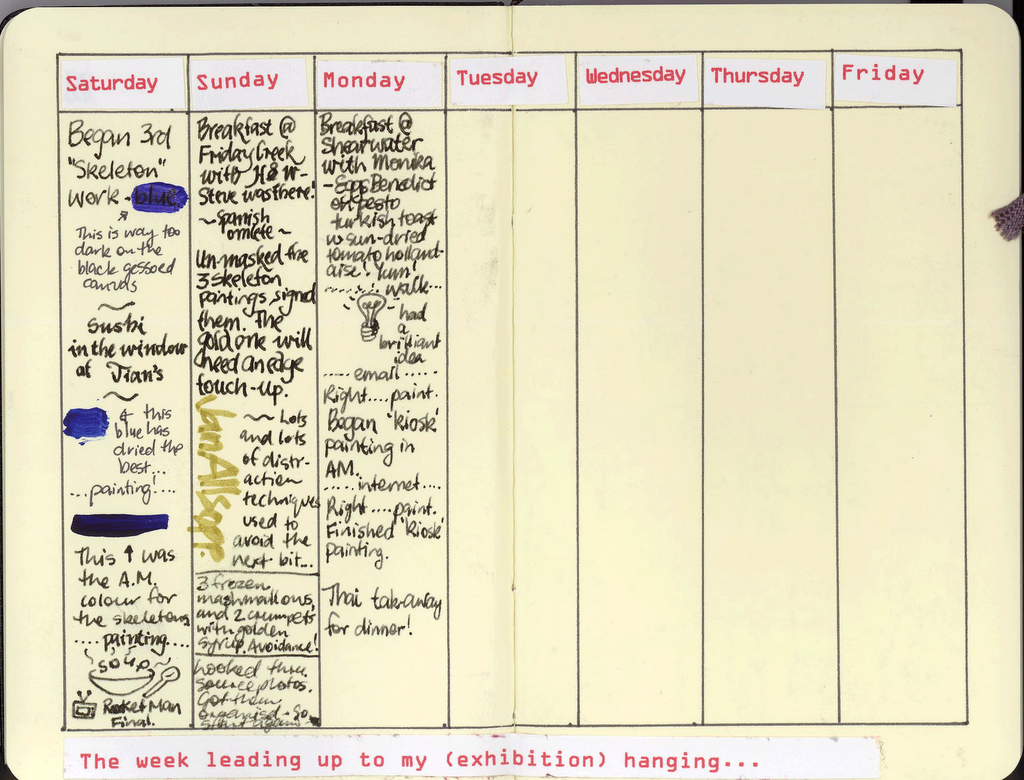
Ok, so I'm progressing. I've decided not to start any more!!! I'm going to focus on finishing. I have such a problem with avoidance and procrastination when working for something like this, actually even to some degree while I'm sketching too.
That is why I have Eric Maisel in the 'guru' part of my side-bar links. He has devoted his working life to helping people like me just simply DO what it is we love doing. A crazy situation!
So if you understand what I'm saying here, and you don't know Eric Maisels books, click the link and check him out.
Ok, Ok! I'm off to paint...